When the Chancellor delivered the Budget on 28 October 2026, many of the announcements came as headlines, with the detail still to follow. The Finance Bill, published a week later, supplies that detail. It turns announcements into draft law, setting out exactly who is affected, what changes, and from when. For businesses that claim R&D relief, and for the founders and investors behind them, it answers several questions the Budget left open. Here is what it means for you.
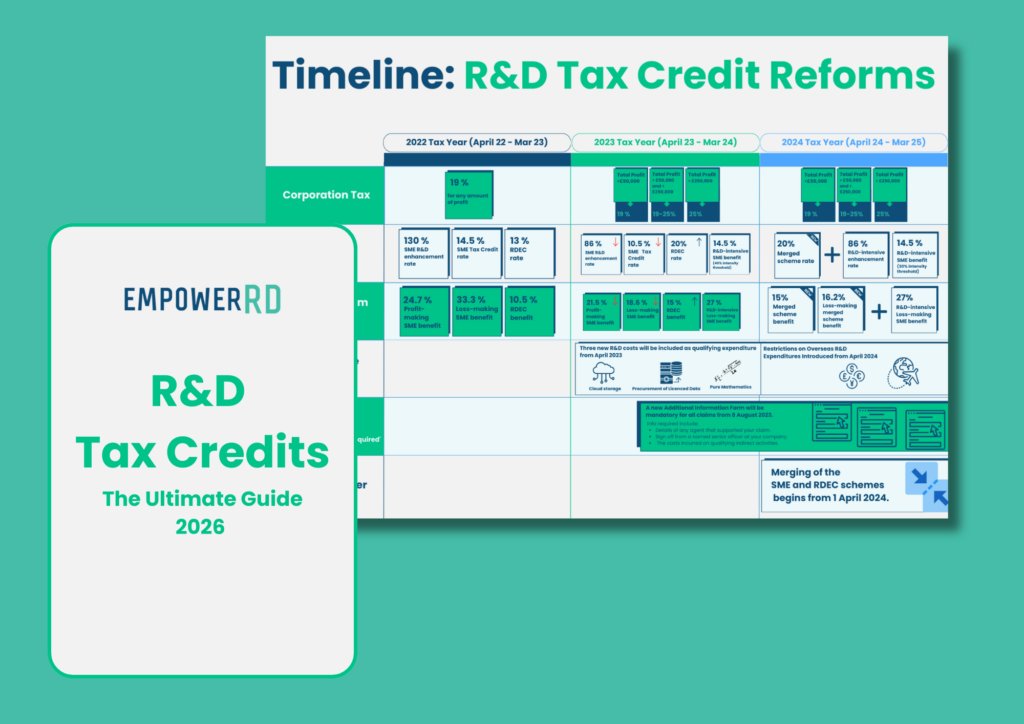
The biggest R&D change in the Finance Bill is an administrative one: from 1 April 2027, companies will no longer need to file a claim notification before making an R&D claim. The rates of R&D relief are untouched, but the Bill tightens HMRC’s hand on errors, changes capital allowances, and reshapes several reliefs that founders and investors use.
The Bill was published on 3 November 2026, following the Budget on 28 October 2026. It runs to over 450 pages. Below, we pull out the measures that matter to R&D-intensive businesses, their directors, and their shareholders, with the dates each one starts.
The Bill is still going through Parliament, so details can change before it becomes the Finance Act 2027.
R&D claims: the claim notification requirement is going
Section 19 repeals the requirement to make a claim notification for R&D relief, for claims made on or after 1 April 2027. It covers the merged scheme expenditure credit and enhanced R&D intensive support (ERIS) alike.
Since 2023, first-time claimants, and companies that had not claimed in the previous three years, had to notify HMRC within six months of the end of their accounting period. Miss that window and an otherwise valid claim was refused. The Bill removes the rule and the regulations that set out what a notification had to contain.
Three points to note:
- The additional information form stays. Only the notification is repealed. The detailed project and cost information HMRC requires with each claim is unchanged.
- The test is when the claim is made, not the period it covers. On our reading, a company that missed a notification window but is still within the two-year time limit for claiming may be able to claim if it files on or after 1 April 2027. Check your own position before relying on this.
- Legacy claims are covered too. Late claims under the old RDEC rules for accounting periods beginning before 1 April 2024 no longer need a notification either, if made on or after 1 April 2027.
The Bill does not change the rates of R&D relief, the definition of qualifying R&D, or the restrictions on overseas costs. Removing a procedural trap does not lower the bar for what a claim must prove. With fewer gates before a claim, the quality of what is in it carries more weight.
Capital allowances: a bigger first-year allowance, a slower main pool
Two changes pull in opposite directions for businesses investing in plant, machinery, and equipment.
| Measure | Change | Starts |
|---|---|---|
| First-year allowance on main rate expenditure (section 45U) | 40% to 50% | Expenditure on or after 1 January 2027 |
| Main rate writing-down allowance | 14% to 12% | 1 April 2027 (companies), 6 April 2027 (income tax) |
Full expensing for companies is unchanged. The 50% allowance matters most where full expensing is not available, for example equipment bought to lease out. Spend that falls into the main pool will be relieved more slowly from April 2027, and accounting periods that straddle the start date get a blended rate.
If a significant equipment purchase is planned for early 2027, the timing is worth reviewing with your accountant. Capital expenditure on R&D facilities can still qualify for 100% research and development allowances, which the Bill does not change.
Getting it right: a new duty to correct errors
From April 2028, a business that finds a mistake in a return it has filed must take reasonable steps to correct it. Leaving a known error in place will be treated as deliberate. This applies to company tax returns, which is where R&D claims sit.
Section 229 and new Schedule 24A create three things:
- A duty to correct. If you know of, or later discover, an inaccuracy in a document sent to HMRC, you must correct it, or tell HMRC if you cannot. Failing to do so means the inaccuracy is treated as deliberate for penalty purposes.
- Correction notices. HMRC can send a notice setting out an error it suspects and a deadline to correct it or explain why it is not an error. Ignore it and the error is presumed careless unless you can show you took reasonable care. Act on it in time and no careless penalty applies, provided you have complied with any other correction notices in the previous six years.
- Longer assessment windows. Under Schedule 17, a loss of tax from an error you discovered but did not report is treated as brought about deliberately. Deliberate behaviour allows HMRC to assess up to 20 years back.
There is a reward for coming forward. A careless error disclosed before HMRC raises it can now have its penalty reduced to 0%.
These rules apply to documents for tax periods ending on or after 1 April 2028. For R&D claimants, a claim later found to include ineligible projects or costs should be corrected promptly, not left to see whether HMRC notices.
The Bill also adds pressure on directors and on poor practice in the market:
- Naming company officers. Where a company has a deliberate penalty and an officer is made personally liable for more than £25,000 of it, HMRC can publish that officer’s name, position, and the details.
- Director disqualification. Courts can disqualify directors for up to five years on conviction of tax security offences committed on or after 1 April 2027.
- Whistleblowing. HMRC’s Strengthened Reward Scheme, which pays individuals who report serious tax avoidance or evasion, is formalised, with tax deducted from rewards at source.
- Promoters. The regime for promoters of tax avoidance schemes is extended to indirect taxes, and HMRC can publish more about stop notices.
Founders, employees, and investors
The largest change for founders is that the lifetime limit for business asset disposal relief halves to £500,000 for disposals on or after 6 April 2027. Share schemes and investment reliefs mostly move in a helpful direction.
| Relief | What changes | Starts |
|---|---|---|
| Business asset disposal relief | Lifetime limit cut from £1 million to £500,000 | Disposals on or after 6 April 2027 |
| EMI share options |
| Options granted on or after 6 April 2027 |
| CSOP share options |
| 6 April 2027 |
| EIS and SEIS |
| Shares issued on or after 6 April 2027 |
| Venture capital trusts | Income tax relief for investors cut from 30% to 20% | Shares issued on or after 6 April 2026 |
| Securities transfer tax | Replaces stamp duty and SDRT on shares at 0.5%, with exemptions for growth markets and new UK listings | A date set by regulations |
On business asset disposal relief, the Bill blocks the obvious workaround. A sale under a contract signed before 6 April 2027 but completed afterwards is taxed under the new limit, unless the contract was signed for genuine commercial reasons and not to secure the old limit. A claim is needed to show this where gains on such contracts exceed £100,000.
For scale-ups, the EMI notification change removes a common way for options to lose their tax advantages: a missed 92-day deadline. The higher CSOP limit gives companies that have outgrown EMI a more useful alternative.
Capital gains tax: what it means for business owners
For business owners planning a sale, the key change is that the lifetime limit for business asset disposal relief halves from £1 million to £500,000 for disposals on or after 6 April 2027. The Bill does not change capital gains tax rates, but it does close the main routes for locking in the current limit.
Business asset disposal relief: the £500,000 limit
Section 8 cuts the lifetime limit for disposals made on or after 6 April 2027. An owner who has not yet used any relief can shelter half as much gain as before. Anyone who has already used £500,000 or more of their allowance will have nothing left after that date.
Schedule 1 sets out how the change applies to deals that straddle the date:
| Situation | How the Bill treats it |
|---|---|
| Contract signed before 6 April 2027, completed on or after it | Taxed when the shares or assets are transferred, so the new limit applies. The exception is a contract with no aim of securing the old limit and, between connected parties, signed wholly for commercial reasons. You must make a claim to rely on this where gains on such contracts exceed £100,000 |
| Share-for-share exchange or reorganisation between 6 April 2025 and 6 April 2027, with the election to crystallise relief made on or after 6 April 2027 | Where the business is still your personal trading company and you work in it, the disposal is treated as happening when the election is made, so the new limit applies |
| Gains deferred under EIS or social investment relief that come back into charge on or after 6 April 2027 | Treated as disposals on that date, so the new limit applies |
In practice, signing heads of terms or a conditional contract before April 2027 will not lock in the £1 million limit. Completion timing and genuine commercial reasons are what count.
Gifting business shares
Section 10 changes how gift holdover relief is restricted when shares in a company or group are given away, for example to family members or a trust. The restriction now also counts assets whose gains are exempt under the substantial shareholding rules, and intangible fixed assets such as intellectual property. For R&D-intensive companies that hold valuable IP or subsidiaries, this can change how much of the gain can be held over. It applies to gifts on or after 6 April 2027.
Compensation for lost contract rights
Schedule 2 confirms that a capital sum received under a contract in return for losing rights under that contract counts as a disposal for capital gains purposes. Examples include a payment to end a licence or a distribution agreement early. This applies to sums received on or after 28 October 2026.
UK property disposals
If a 60-day return for a UK property disposal is late, the obligation now ends once the full self assessment return including that disposal is filed. Late-filing penalties then stop running. This applies where the self assessment return is delivered on or after 28 October 2026.
What business owners should do
- Selling in the next 18 months? Plan completion dates against 6 April 2027 now, and keep a record of the commercial reasons for the timing.
- Recently restructured? If a share exchange or reorganisation since April 2025 left the relief election open, take advice before 6 April 2027.
- Passing shares to family? Check how the revised holdover restriction applies if the company holds IP or other company shares.
Other changes worth knowing
Corporation tax stays at 25% main rate and 19% small profits rate for the year from April 2028. Beyond that, a handful of measures will touch some R&D businesses:
- Hiring overseas talent. Where an employer pays a certificate of sponsorship fee or the immigration skills charge, the employee no longer faces an income tax charge on it. This applies to payments from 28 October 2026.
- Overseas branches. The exemption for profits of foreign permanent establishments becomes compulsory, not elective, for accounting periods from 1 January 2027. Companies with overseas branches that previously used branch losses in the UK should check the transitional rules restricting carried-forward losses.
- Large groups. Groups within the global minimum tax (Pillar Two) can elect to treat qualifying, substance-based tax incentives more favourably when calculating their effective tax rate. Larger claimants should ask their advisers how R&D relief interacts with this.
- Personal tax on savings and property income. Rates rise to 24%, 44%, and 49% for 2027-28.
- E-invoicing. HMRC gains powers to require VAT invoices in an electronic format, with details to follow in regulations.
What the Bill does not do matters too. It makes no change to the merged scheme expenditure credit rate, ERIS, the definition of R&D, or the restrictions on overseas R&D costs.
| Date | Change |
|---|---|
| 28 October 2026 | Immigration skills charge and sponsorship fees no longer taxable on employees |
| 1 January 2027 |
|
| 1 April 2027 |
|
| 6 April 2027 |
|
| 1 April 2028 | Duty to correct errors and correction notices apply to tax periods ending on or after this date |
What to do now
- Planning a first R&D claim? Until 1 April 2027 the notification rule still applies. If your accounting period ended within the last six months, notify HMRC now rather than relying on the change.
- Missed a notification deadline? Talk to us about whether a claim made after 1 April 2027 could be within time.
- Review past claims. The duty to correct is coming. If you have doubts about a previous claim, an unprompted disclosure now is the lowest-risk route.
- Founders considering a sale. Take advice before 6 April 2027 on business asset disposal relief and the contract timing rules.
- Granting share options. Check whether your scheme documents and processes need updating for the EMI and CSOP changes.
Fewer procedural hurdles and tougher rules on errors point the same way: HMRC wants claims that are right first time. That is how we build them. Our tax specialists work with you on our collaboration platform to put together claims that stand up to scrutiny, across Projects, Costs, and HMRC Submission. Across 1,200+ clients and over £260m in successful claims, our HMRC enquiry rate is below 5%.
Want to know how the Finance Bill affects your next claim? Book a call with our team →
This article summarises the Finance Bill as introduced on 3 November 2026. It is not tax advice, and the Bill may change during its passage through Parliament.