The UK government just announced a £500 million Sovereign AI Unit — a state-backed investment vehicle designed to keep British AI companies on home soil and push them to global scale. It’s a significant policy moment. And for CFOs and Financial Controllers at innovative UK companies, it raises a question that nobody in a government press release is asking: when the government doubles down on AI investment, what does HMRC do next?
The answer matters more than the headline.
What just happened — and why it’s more than a funding story
The UK government has unveiled a £500m push to scale domestic AI firms, with Tech Secretary Liz Kendall launching the new Sovereign AI Unit as a central pillar of the UK’s tech industrial strategy. It is designed to be different from any previous government-backed unit, acting like a venture capital fund with the muscle of the state behind it.
Support goes beyond funding alone: startups backed by Sovereign AI will gain access to compute — fully funded access to the UK’s largest AI supercomputers, with up to 1 million GPU hours available per startup — alongside fast-track global talent visas and hands-on government support navigating data access, procurement, and regulation.
The unit has been designed to address a longstanding gap in the UK ecosystem, where companies often excel at early-stage innovation but struggle to scale and compete on a global scale.
This is a real and welcome commitment. But read it carefully: the government is not broadening who qualifies. It is concentrating resources on a narrow group of strategically chosen AI companies. For the thousands of innovative UK businesses outside that cohort — the ones whose core funding mechanism is still the R&D tax credit regime — this announcement changes the competitive and regulatory context around your claim.
More government attention on AI innovation means possibly more HMRC attention on AI claims
When government commits £500m to a sector and frames it as a national security priority, HMRC takes notice. That is not speculation — it is a pattern. The R&D tax credit scheme is already under more scrutiny than it has been at any point in its history.
In recent years, HMRC has intensified scrutiny of R&D tax credits due to historic instances of fraud and errors, and while the agency has taken measures to address misuse of the system, some professional organisations and tax advisers have expressed concerns that its approach may be excessively stringent, leading to the rejection of valid claims.
HMRC’s heightened scrutiny of R&D claims and the marked increase in enquiry activity have deterred many smaller claimants. For companies without the internal expertise or external representation to handle a lengthy HMRC review, the perceived risk and cost of potential challenge often outweigh the prospective benefit.
Now layer in what else is happening. In a landmark ruling, the First-tier Tribunal revealed that HMRC had been using artificial intelligence to assess and reject R&D tax relief claims — without public disclosure. Judge Alexandra Marks found the arguments for transparency “compelling,” noting that secrecy around AI undermines taxpayer trust and could deter legitimate claims.
The environment is clear: more government attention on AI as a strategic sector, more HMRC scrutiny of what counts as qualifying R&D, and an increasingly automated compliance apparatus reviewing your claim. If your technical narrative isn’t built to withstand that, a policy win for British AI broadly is not a win for your business specifically.
The scaling gap is real — and it creates a claims risk most CFOs haven’t priced in
The Sovereign AI Unit exists because many startups struggle to transition from breakthrough research into large-scale commercial success — a gap the government hopes Sovereign AI will close. Policymakers have increasingly voiced concern that promising companies are either sold early or shift operations abroad due to funding constraints and market access challenges.
That scaling gap is also exactly where R&D tax credit claims get complicated. The companies most likely to be in or near the Sovereign AI cohort — companies building foundation models, inference infrastructure, physical AI, engineering biology — are also the companies whose R&D claims carry the most technical complexity and the most HMRC risk.
With HMRC increasing its focus on fraudulent or exaggerated R&D claims, any AI-generated technical report or financial justification is likely to be subject to heightened scrutiny. R&D tax relief is a highly complex area requiring an understanding of evolving legislation, nuanced eligibility rules, and contractual relationships.
If you are working in deep tech, AI infrastructure, or advanced engineering, your qualifying activities are genuinely complex. That complexity is not an obstacle — it is the substance of a strong claim. But it has to be articulated precisely, documented rigorously, and built to survive a challenge. Not summarised. Not templated. Built.
What this means for your R&D claim
The Sovereign AI announcement does not change the R&D tax credit rules. But it changes the environment in which your claim will be reviewed. Here is what to act on now:
- If you are an AI or deep tech company currently claiming R&D relief: The government has just put your sector in a national spotlight. That is good for your industry and your funding narrative — but it also means HMRC will be asking harder questions about what genuinely constitutes advancement in the field and what is routine software development dressed up in technical language. Your claim needs to hold that line clearly.
- If you have received Sovereign AI backing or Compute Access: The R&D tax credit scheme and Sovereign AI support are not mutually exclusive, but they interact. Government grants and notified state aid affect the costs you can claim and the scheme you claim under. This needs to be reviewed before your next submission — not after.
- If you are scaling fast: Rapid headcount growth, new subcontracted R&D, and overseas compute costs are all areas where claiming R&D relief in 2026 requires greater evidence, technical accuracy, and strategic readiness than ever before. Scaling is not a reason to deprioritise claim quality. It is a reason to invest in it.
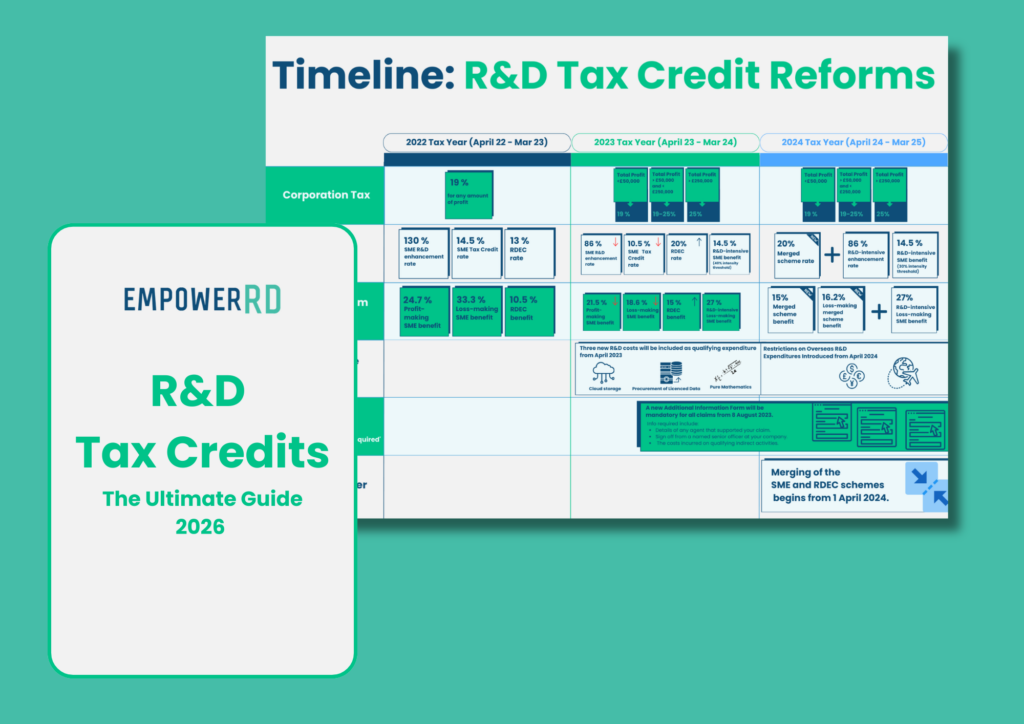
- If you haven’t had your claim independently reviewed recently: The merged RDEC scheme, the Enhanced R&D Intensive Support (ERIS) rules, and the Additional Information Form requirements have all shifted what a defensible claim looks like. The system is evolving, and the threshold for a compliant, robust claim is rising. Companies that invest in strong technical documentation, understand the new qualifying boundaries, and plan early will be best placed to benefit.
A strong R&D claim isn’t built at the moment of submission. It’s built in the technical decisions, the documentation, and the narrative your team constructs throughout the year.
Are you interested in finding out how EmpowerRD can support your R&D tax claim? Get in touch with our team.